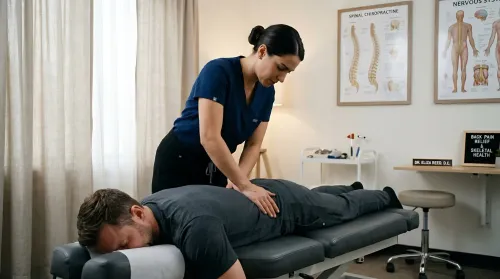

Hands-on treatment can reduce pain and make restricted movement easier, but a temporary feeling of being straighter is not the same as permanent spinal realignment. You will learn how to judge whether manual therapy fits your symptoms, what a useful appointment includes, and which exercises and safety checks support lasting improvement.
Key takeaways
- Manual therapy eases pain and stiffness but does not permanently realign a normal spine.
- An assessment identifies movement restrictions, pain triggers, and posture habits worth treating.
- Exercises and regular movement turn short-term mobility gains into lasting improvements.
- Choose a registered physiotherapist who explains risks, goals, and a home programme.
What manual therapy can change about posture
Hands-on treatment can temporarily improve how you hold and move your body by reducing pain, easing stiffness, and increasing comfortable range—not by permanently realigning a normal spine. A physiotherapist may use manual therapy for posture to make restricted movement easier, then use that short-term improvement for active retraining.
It may influence posture through:
- Joint mobilisation or manipulation that reduces resistance in a stiff area, such as limited thoracic rotation or painful neck movement.
- Soft-tissue techniques that reduce tenderness and protective muscle guarding.
- Gentle assisted movement that exposes a restricted position without forcing it.
- Temporary changes in muscle length and tolerance, making a more upright or balanced position feel less strained.
You might leave with a freer turn, less shoulder tension, or a more comfortable sitting position. Feeling “straightened” after treatment does not prove that bone shape changed or that a structural deformity was corrected. The effect can fade without active retraining and repeated daily practice.
For persistent low-back pain, NICE recommends manual therapy only within a treatment package that includes exercise, with or without psychological therapy; it is not a stand-alone posture-correction treatment. New neurological symptoms, severe unremitting pain, or pain after major trauma require medical assessment instead of routine posture care.
When an assessment makes manual therapy relevant
A physiotherapist makes manual therapy relevant when changing a movement or symptom produces a useful difference, not when a photograph shows a deviation. The assessment links the posture pattern to pain or lost function through your symptom history, work or sport demands, medical history, movement, strength, endurance, and response to a simple position change.
Rounded shoulders, forward head, or pelvic tilt alone do not prove tissue damage or cause pain.
| Finding | What it suggests | Useful test |
|---|---|---|
| Restricted thoracic rotation | The upper back limits reaching or turning | Compare rotation before and after mobilisation |
| Painful neck movement | Cervical loading contributes to symptoms | Recheck pain and range after treatment |
| Limited hip mobility | Sitting, walking, or lifting mechanics are affected | Test the task with changed hip movement |
| Poor shoulder-blade control | Arm movement depends on compensatory tension | Reassess reaching with guided control |
Manual therapy becomes reasonable when mobilisation or soft-tissue work changes pain, range, or movement tolerance during that session. The therapist then measures function such as sitting, walking, lifting, sleep, or work tolerance, alongside pain, strength, range of motion, or a validated disability questionnaire.
A temporary improvement in posture is not permanent spinal realignment; exercises and movement practice must build lasting capacity.
Do not treat new neurological deficits, progressive weakness, saddle numbness, bladder or bowel changes, major trauma, fever, unexplained weight loss, suspected fracture, or severe unremitting pain as routine posture problems. Persistent low-back pain requires manual therapy, if used, alongside exercise rather than as a stand-alone treatment.
What happens during a posture-correction appointment
Expect an appointment to test whether your posture relates to pain, stiffness, or restricted movement—not to diagnose you from a photograph or promise permanent spinal realignment.
1. History: You will describe symptoms, work or sport demands, sitting tolerance, previous injuries, surgery, and what aggravates or eases the problem. Tell the physiotherapist about osteoporosis, recent fracture or surgery, inflammatory disease, bleeding risk or anticoagulants, cancer history, pregnancy, vascular disorders, and neurological symptoms.
2. Movement assessment: The physiotherapist may observe cervical movement, thoracic rotation, shoulder-blade control, hip mobility, strength, balance, and breathing or lifting patterns. The aim is to find a movement limitation that matches your symptoms; a rounded shoulder or forward head alone does not prove damage.
3. Hands-on treatment: Manual therapy for posture may include joint mobilisation, manipulation, soft-tissue work, or assisted movement. Treatment can reduce pain sensitivity, ease stiffness, or improve comfortable range temporarily, making active exercise easier; an immediate feeling of being “straightened” does not confirm a structural change.
4. Exercise plan: You should leave with specific exercises for mobility, strength, motor control, and gradual exposure to sitting, work, or sport demands. The plan should fit your symptoms and available time, not simply prescribe generic “posture” drills.
5. Reassessment: The clinician should repeat a relevant movement or task and compare pain, range, control, or tolerance with the starting findings. If nothing changes, ask whether the technique, diagnosis, or treatment goal needs revising.
Why exercises and daily movement determine lasting results
An easier neck turn or a less painful squat after treatment creates a window for practice; it does not prove that your spine has been permanently “realigned.” Manual therapy can reduce pain sensitivity, ease stiffness, or improve movement tolerance, but the nervous system still needs repeated, active practice to retain that change.
Lasting improvement depends on four adaptations:
- Strength lets the neck, trunk, hips, or shoulder muscles share load instead of allowing one irritated area to do all the work.
- Motor control teaches you to coordinate those muscles during reaching, walking, lifting, sitting, or turning—not just while holding a clinic exercise position.
- Mobility preserves the range gained during treatment. Without regular movement, a stiff thoracic spine, hip, or shoulder can restrict the same posture again.
- Gradual exposure rebuilds tolerance. Increasing sitting time, lifting load, walking distance, or overhead activity in small steps reduces the cycle of avoidance followed by flare-ups.
Daily movement matters more than a single “perfect posture” drill. Change position, take short walking breaks, and practise the prescribed movements at the frequency and difficulty given; overcorrecting into a rigid pose can increase fatigue and discomfort.
Progress should be judged by useful tasks: turning your head to check traffic, standing through a workday, climbing stairs, or lifting a bag. For persistent low-back pain, NICE recommends manual therapy only within a package that includes exercise, with or without psychological therapy, rather than as a stand-alone posture treatment.
How to choose safe posture correction care in Bengaluru
Before booking, ask the clinic to define what success will look like. “Better posture” is too vague; a useful goal might be less neck pain while working, improved thoracic rotation, or sitting for 45 minutes without stiffness.
- Which finding links my posture to my symptoms, and what will you measure?
- Which technique will you use: mobilisation, soft-tissue work, assisted movement, or high-velocity manipulation?
- What benefit should I expect, how many sessions will you review, and what exercises will accompany the hands-on work?
- What would make you stop treatment or refer me for medical assessment?
| Question | A useful answer | Warning sign |
|---|---|---|
| Goal | A symptom, movement, or activity target with a review date | A promise to permanently realign your spine |
| Technique | The named technique, intended effect, risks, and alternatives | “Posture correction” without an explanation |
| Safety | A screening of medical history and neurological symptoms | No questions about risks before manipulation |
| Progress | Repeatable measures such as pain, range of motion, strength, or work tolerance | Progress judged only by photographs |
| Follow-up | A home programme and a planned reassessment | Repeated hands-on sessions with no exercise plan |
Tell the clinician about osteoporosis, recent fracture or surgery, inflammatory disease, bleeding disorders, anticoagulants, cancer history, vascular disease, pregnancy, or numbness and weakness. For persistent low-back pain, NICE places manual therapy within a package that includes exercise, not as a stand-alone treatment.
A Bengaluru clinic such as Apex Physiotherapy should be able to explain these decisions clearly before you start manual therapy for posture correction in Bengaluru or any posture correction treatment in Bengaluru.
Related service
Manual Therapy Manual Therapy is a specialized hands-on physiotherapy technique designed to reduce pain, improve mobility, restore joint function, and accelerate... View service → |
Frequently asked questions
Can manual therapy permanently correct posture?
No. Manual therapy can reduce pain and stiffness and improve comfortable movement, but lasting posture changes require active retraining and daily movement.
When is manual therapy relevant for posture correction?
It is relevant when an assessment finds pain, joint stiffness, restricted range, muscle guarding, or movement habits that limit comfortable posture.
What happens during a posture-correction appointment?
The physiotherapist discusses your symptoms, observes standing and movement, checks relevant joints and muscles, explains findings, and may use hands-on treatment followed by exercises.
Do exercises matter after manual therapy?
Yes. Exercises and regular movement help you use the improved range and build strength, coordination, and endurance for lasting results.
How do you choose safe posture correction care in Bengaluru?
Choose a qualified physiotherapist who performs an assessment, explains the treatment plan, obtains consent, screens for warning signs, and provides clear self-management advice.
Keywords