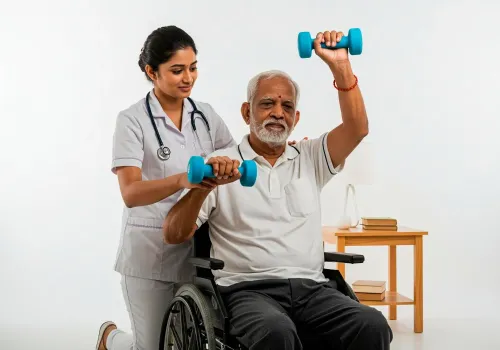

A conditioning session is not a generic gym workout: it links exercise intensity, movement quality, balance, walking, transfers, and daily tasks to your neurological condition and safety. By the end, you will know what the assessment checks, what a typical session includes, how exercises are adapted, and which measurements show whether you are improving.
Key takeaways
- Expect strength, balance, coordination, endurance, and movement-tolerance training.
- Complete an assessment before starting a conditioning programme.
- Exercises are adapted to weakness, spasticity, tremor, fatigue, or poor coordination.
- Track progress with functional goals, movement quality, repetitions, and daily activity tolerance.
What neuro rehabilitation conditioning includes—and who needs it
Neuro rehabilitation conditioning means building the strength, endurance, balance, coordination, and movement tolerance needed for safer daily activity. Neuro rehabilitation conditioning in Bengaluru is not one standard treatment; it is a personalised exercise-and-function programme within broader care.
| Approach | Main purpose | What makes it different |
|---|---|---|
| General neuro rehabilitation | Restore movement and independence | May include gait training, transfers, range of motion, speech or swallowing support, and task practice |
| Neuro conditioning | Improve capacity for repeated activity | Uses graded aerobic work, strengthening, balance, coordination, and functional tasks without exceeding neurological or cardiovascular limits |
| Gym exercise | Improve fitness | Usually lacks neurological assessment, guarding, symptom monitoring, and adaptations for tone, sensation, cognition, or falls |
| Sports injury prevention conditioning | Reduce injury risk during sport | Uses progressive strength, landing and deceleration drills, proprioception, running-load management, and sport-specific changes of direction |
People commonly need conditioning after:
- Stroke or traumatic brain injury
- Parkinson’s disease or multiple sclerosis
- Spinal-cord injury or cerebral palsy
- Vestibular disorders causing dizziness or poor balance
- Peripheral nerve injury, weakness, or reduced sensation
The programme may also address fatigue, poor trunk control, foot drop, tremor, or difficulty walking.
Home exercises should state repetitions or time, assistance, rest periods, safety setup, and symptoms that mean “stop.” That practical adaptation is central to neuro rehabilitation in Bengaluru, where stairs, uneven surfaces, bathrooms, transport, and available family help shape what you can safely practise.
What happens before your first conditioning programme begins
A programme should not begin with exercise selection. The therapist first confirms the neurological diagnosis, surgery or injury history, medications, falls, pain, fatigue, and current daily activities, then checks whether your medical status is stable enough for exertion.
Readiness assessment usually includes strength, range of motion, muscle tone or spasticity, sensation, coordination, balance, walking, transfers, cognition, communication, and cardiopulmonary tolerance. The therapist also watches how you turn, stand, recover from a loss of balance, follow instructions, and manage fatigue.
In neuro rehabilitation in Bengaluru, these findings should lead to functional goals such as walking to the bathroom, transferring safely, climbing steps, or using a wheelchair independently—not strength scores alone.
Stop the assessment and obtain medical review for:
- New weakness, sudden speech or vision changes, a new severe headache, or sudden neurological worsening
- Chest pain, fainting, severe breathlessness, fever, or an uncontrolled seizure
- A new loss of bladder or bowel control
| Finding | What it tells the therapist | Programme decision |
|---|---|---|
| Poor balance or repeated falls | High risk during standing and walking | Begin with guarding, transfers, and supported balance |
| Orthostatic symptoms | Blood-pressure regulation may be impaired | Check position changes and exertion tolerance before conditioning |
| Severe fatigue or cognitive difficulty | You may not sustain long or complex sessions | Use short intervals, simple cues, and planned rest |
| Pain, dyskinesia, or freezing in Parkinson’s disease | Timing and movement strategy affect safety | Coordinate activity with medication and use cueing or turning practice |
What happens during a typical conditioning session
A conditioning session usually begins with a readiness check, moves from easier to more demanding tasks, includes planned rests, and ends with specific home instructions. The therapist adjusts the plan if fatigue, pain, blood pressure, balance, or alertness changes.
1. The therapist checks your current symptoms, pain, fatigue, breathing, pulse or blood pressure when needed, and ability to sit, stand, transfer, or walk safely. Report a new weakness, chest pain, fainting, unusual breathlessness, sudden neurological change, or loss of bladder or bowel control immediately.
2. You begin with gentle warm-up movements, breathing work, range-of-motion exercises, or low-intensity cycling and stepping. This prepares stiff or weak muscles without using early energy on difficult tasks.
3. Neuro conditioning physiotherapy then targets a functional goal through repeated sit-to-stand, stepping, walking, turning, reaching, stair practice, transfers, balance drills, or coordination work. Strengthening and aerobic work are added when your control and cardiovascular status permit.
4. Rest periods are planned rather than delayed until exhaustion. The therapist may alternate walking with seated work, reduce repetitions, or stop an exercise when your movement becomes unsafe or your technique deteriorates.
5. You finish with easier movements, positioning, and a review of symptoms. Your written home programme should state the exercise, repetitions or time, required assistance, safety setup, rest periods, and the symptoms that mean stop.
Caregivers may learn guarding and transfer techniques, but they should not lift you beyond their ability or replace professional reassessment. Progression comes through controlled repetition, not simply pushing until you are exhausted.
How exercises are adapted for neurological movement problems
The same exercise is changed according to the movement problem, not simply repeated at a lower intensity. Neuro conditioning physiotherapy may use supported positions, slower speed, external cues, shorter sets, extra rest, or hands-on assistance so you practise safely without reinforcing poor movement.
- Weakness: use lighter resistance, fewer repetitions, assisted movement, and gradual loading; stop before form collapses.
- Spasticity: move slowly through comfortable range, avoid sudden stretches, and add positioning, weight-bearing, and prolonged muscle lengthening.
- Rigidity: use large-amplitude movements, rhythm, trunk rotation, and visual or auditory cues to reduce small, stiff steps.
- Tremor: stabilise the limb, use supported positions, controlled breathing, and shorter tasks instead of demanding precise unsupported movements.
- Ataxia: slow the pace, widen the base of support, add hand support, and use visual targets for accurate stepping.
- Foot drop: practise toe clearance and dorsiflexion, strengthen safely, and consider an ankle-foot orthosis during walking.
- Sensory loss: increase visual feedback, check skin and joint position, and remove hazards because pain may not warn you.
- Neglect: place targets on the ignored side and train scanning, head turning, and reaching toward it.
- Poor trunk control: begin seated with back or hand support, then reduce support as balance improves.
- Wheelchair use: train propulsion, pressure relief, transfers, reaching, and strength without overloading the shoulders.
- Cognitive fatigue: shorten blocks, give one instruction at a time, schedule rests, and practise when attention is strongest.
Movement rehabilitation in Bengaluru also needs to match your stairs, bathroom, footwear, transport, and outdoor surfaces.
How progress is measured and how to choose practical support
Progress is real when daily tasks become safer, not merely when a muscle produces more force. Compare baseline and repeat results for walking speed, transfer ability, balance, fatigue, falls, and the assistance you need for dressing, toileting, stairs, or community mobility.
| Measure | Improvement to look for | Practical meaning |
|---|---|---|
| 10-Metre Walk Test | Faster speed without loss of control | Safer household and outdoor walking |
| Timed Up and Go | Less time to stand, walk, turn, and sit | Better fall-risk management |
| Five-Times Sit-to-Stand | Fewer seconds with steady alignment | Easier chair and toilet transfers |
| Six-Minute Walk Test | Greater distance with controlled fatigue | More endurance for daily activities |
| Stairs or transfer observation | Fewer prompts or less physical help | Increased independence at home |
When comparing movement rehabilitation in Bengaluru, ask how the service will measure these tasks and adapt them to your actual bathroom, stairs, footwear, transport, and outdoor surfaces. A clinic that records only strength or exercise repetitions can miss unsafe turning, impulsive movement, or fatigue-related errors.
- A written home plan stating repetitions, rest periods, required assistance, equipment, and stop symptoms.
- Progression based on movement quality and safety, not a fixed calendar.
- Caregiver instruction for guarding and transfers without asking them to lift beyond their ability.
- Planned reassessment after a defined number of sessions.
- Experience with neuro rehabilitation conditioning in Bengaluru and a clear route for medical review if symptoms change.
Apex Physiotherapy is worth comparing on whether its assessment and home instructions match your real environment, rather than relying on a generic exercise sheet.
Related service
Neuro Rehabilitation Neuro Rehabilitation is a specialized physiotherapy treatment focused on improving movement, strength, balance, coordination, and independence in... View service → |
Frequently asked questions
What does neuro rehabilitation conditioning include?
It includes personalised exercises for strength, endurance, balance, coordination, movement tolerance, and safer daily activity.
What happens before the first conditioning programme begins?
A physiotherapist assesses your neurological movement problems, current function, goals, safety needs, and exercise tolerance before planning sessions.
How are exercises adapted for neurological movement problems?
The programme is adjusted for issues such as weakness, spasticity, tremor, fatigue, balance loss, or poor coordination.
How is progress measured during neuro rehabilitation conditioning?
Progress is tracked through functional goals, exercise performance, movement quality, repetitions, endurance, balance, and daily activity tolerance.
Keywords