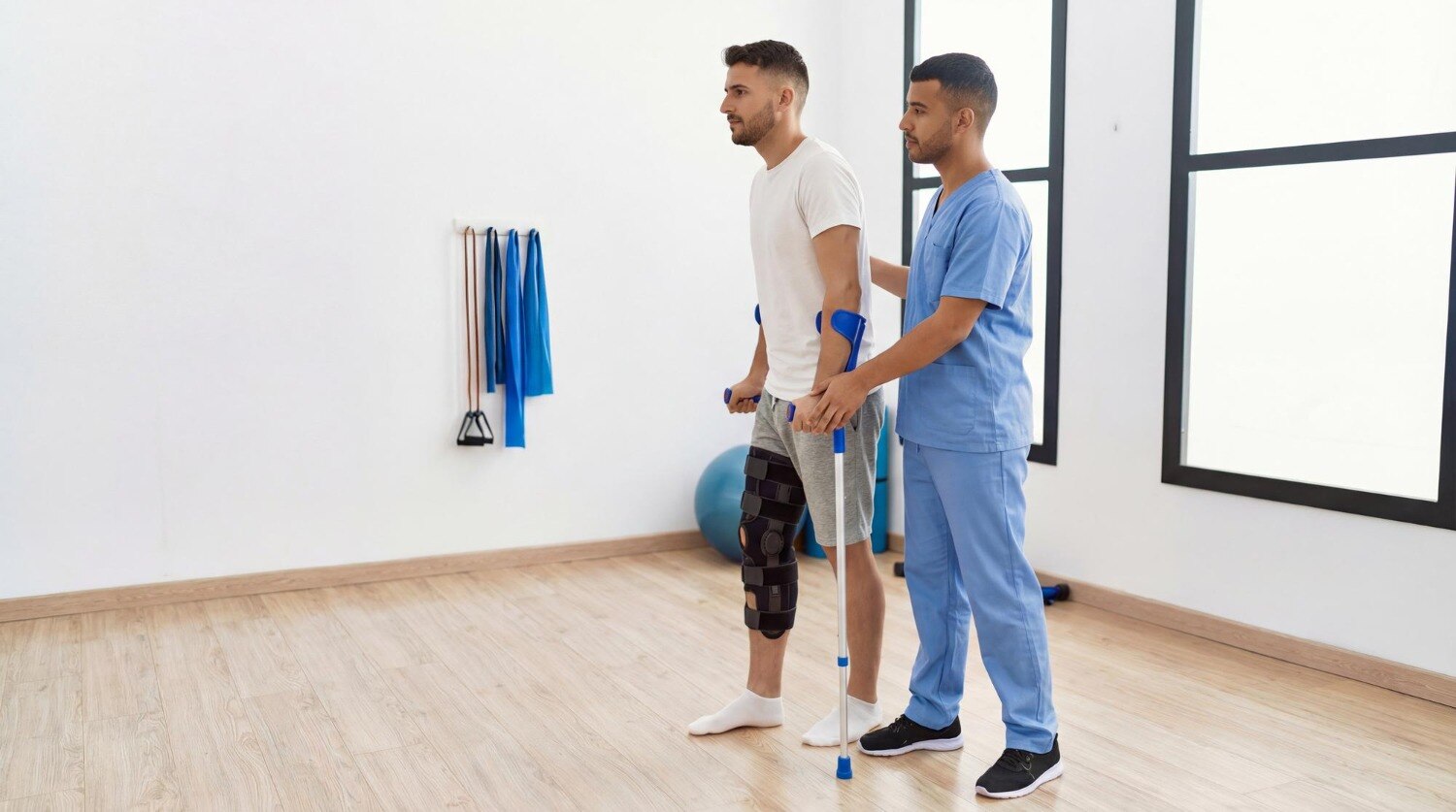
Pre-surgery rehabilitation can improve strength, movement control, and confidence before an operation, but it cannot guarantee that a torn ligament, repaired tendon, or unstable joint will avoid surgery or another injury. You will be able to judge when preoperative sports rehabilitation is appropriate, what it should measure, and how to exercise without aggravating the condition.
Key takeaways
- Start after diagnosis, once the surgeon and physiotherapist agree on safe activity.
- Track pain, swelling, joint movement, strength, stability, and walking or sport-specific function.
- Use graded exercises that protect the injured joint rather than copying a gym programme.
- Choose supervision when weakness, instability, swelling, or surgical restrictions limit safe training.
What can pre-surgery rehabilitation prevent before a sports operation?
Pre-surgery rehabilitation cannot reliably prevent the original sports injury when a structural lesion already needs an operation. Its purpose is to reduce weakness, stiffness, swelling, instability, and reinjury risk after diagnosis—not to promise that surgery can be avoided.
Any claim that pre surgery rehabilitation for sports injury prevention in bengaluru guarantees a non-surgical outcome is misleading.
Before ACL reconstruction, a quiet knee with minimal effusion, full extension, useful flexion, and well-activated quadriceps gives you a better starting point for recovery. Prehabilitation may improve strength, movement control, and confidence, but recurrent giving-way can cause further meniscal or cartilage damage.
- Ask the orthopaedic surgeon and physiotherapist to decide whether supervised preparation is appropriate for ACL reconstruction, meniscus repair, rotator cuff repair, shoulder stabilisation, Achilles tendon repair, ankle ligament reconstruction, or fracture fixation.
- Match exercises to the lesion, planned operation, allowed weight-bearing, permitted knee or shoulder motion, and restrictions on open-chain loading. An ACL programme is not a safe template for meniscus, tendon, shoulder, cartilage, or fracture surgery.
- Use a home programme, supervised progression, sleep and training-load advice, and clear rules for reporting increased swelling, pain, instability, or neurological symptoms.
- Discuss any delay with the surgeon before conditioning. After repeated ACL instability, do not treat sports injury prevention before surgery as an open-ended substitute for indicated surgery.
The operation, tissue damage, surgeon’s restrictions, and risk of repeated giving-way determine the plan. Conditioning is useful only when loading the joint does not create more harm.
When should you start, and what should the preoperative assessment record?
Start as soon as the diagnosis and surgical plan are clear; even a few days can improve what you take into surgery. If you are looking for pre surgery rehabilitation in Bengaluru, ask for an assessment before choosing exercises, because the procedure, tissue involved, and surgeon’s restrictions determine safe loading.
A short, supervised period can target:
- Swelling and effusion control
- Full knee extension and useful flexion
- Quadriceps activation
- Hamstring strength
- Single-leg balance and function
Several weeks allow progressive resistance, conditioning, deceleration, landing, and sport-specific testing. A programme lasting only a few sessions still has value when it identifies deficits, teaches a home programme, and gives you clear loading limits.
The preoperative sports rehabilitation record should include:
- Pain level and response after exercise
- Effusion, range of motion, and joint stability
- Strength asymmetry, including quadriceps and hamstrings
- Balance, gait, and movement quality
- Current training load and recent changes
- Sport demands such as hopping, landing, cutting, sprinting, or overhead work
Feeling comfortable at rest does not prove readiness. Baseline and repeat measures can reveal weak quadriceps, restricted extension, poor single-leg control, or instability that symptoms conceal.
Your plan should specify supervised sessions, home exercises, sleep targets, training-load adjustments, and when to contact the clinician. Contact them for increasing swelling, lost motion, repeated giving-way, new neurological symptoms, or pain that does not settle after loading.
Which exercises are used, and how are they changed for an injured joint?
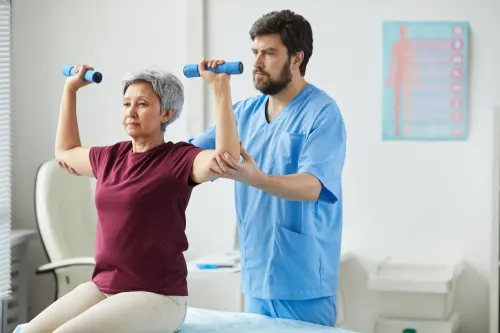
Exercises are selected to restore useful strength and control without violating the surgical plan. Preoperative sports rehabilitation can include quadriceps and hamstring strengthening, hip and gluteal control, calf raises, rotator-cuff loading, balance and proprioception drills, joint mobility, and low-impact cycling or other cardiovascular conditioning.
Sports injury prevention physiotherapy adds landing, deceleration, and change-of-direction practice only when the joint can tolerate it.
Pain or swelling changes the dose, not the purpose. The therapist may reduce range, resistance, speed, impact, or exercise volume instead of forcing progression. An unstable knee may stay in controlled positions, excluding cutting, pivoting, and jumping; immobilisation may restrict movement and weight-bearing.
| Procedure | Typical exercise limits | Why an ACL programme cannot be copied |
|---|---|---|
| Meniscus repair | Follow surgeon-set limits for weight-bearing and knee flexion; avoid loaded twisting | Deep flexion or rotation can stress the repair |
| Shoulder surgery | Protect the repair, then progress permitted range and rotator-cuff loading | Knee strengthening does not address shoulder protection or overhead limits |
| Achilles repair | Respect immobilisation, ankle position, and staged weight-bearing | Calf raises can be unsafe before tendon healing allows them |
| Fracture fixation | Progress movement and loading only after fixation and imaging guidance | Strength work cannot override bone-healing restrictions |
| Cartilage or tendon procedure | Use tissue-specific limits on compression, stretching, and resistance | Excess loading can irritate or damage the treated tissue |
Ask the orthopaedic surgeon and physiotherapist which movements, resistance, and weight-bearing level are allowed. Meniscal, cartilage, tendon, shoulder, and fracture procedures require procedure-specific progression; do not borrow an ACL protocol without approval.
How does preoperative rehabilitation differ from gym training and injury-prevention work?
Preoperative rehabilitation is not the same as general gym conditioning or sports-performance training: it is exercise selected around an injured structure, surgical plan, and reinjury risk.
| Approach | Main aim | What guides progression |
|---|---|---|
| Ordinary gym conditioning | General strength and fitness | Fitness goals, exercise tolerance, and technique |
| Sports-performance training | Speed, power, agility, and sport-specific exposure | Sport demands, performance targets, and training load |
| Physiotherapy-led injury prevention | Manage symptoms, asymmetry, movement technique, and reinjury risk | Clinical assessment, tissue healing, stability, pain, swelling, and surgeon restrictions |
After an injury has occurred, the safe exercise range becomes narrower. A therapist may limit resistance, range, speed, impact, or volume because a healing tendon, meniscus, ligament, bone, or repaired shoulder cannot be loaded like an uninjured joint.
FIFA 11+ shows useful prevention principles: running, strength, balance, and plyometrics. A sports injury prevention physiotherapy plan may borrow these elements, but it must remove or modify drills that cause pain, swelling, instability, or loss of movement. Do not copy a team warm-up into a sports injury prevention before surgery programme without clinical approval.
Repeated adherence matters more than completing one impressive session. Follow the home programme, attend planned progressions, manage training load and sleep, and judge success by improved function without increased swelling or instability.
Stop increasing intensity and seek reassessment for:
- Increasing effusion or lost extension
- Night pain or disproportionate pain
- Giving way or new instability
- Numbness, weakness, or other neurological symptoms
- Calf swelling or fever
How do you choose supervised pre-surgery rehabilitation in Bengaluru?
Choose care that is tied to your operation, not a generic “sports” package. For pre surgery rehabilitation in Bengaluru, ask whether the physiotherapist will review your orthopaedic diagnosis and planned procedure, then communicate restrictions with your surgeon. Meniscal repair, ACL reconstruction, tendon repair, and cartilage procedures do not share the same limits.
Ask for these items before you commit:
- Baseline and repeat measurements of knee or shoulder range of motion, swelling, pain response, strength, balance, and movement quality.
- Sport-specific testing, such as hopping, landing, cutting, deceleration, sprinting, or overhead work, only when medically safe.
- Written rules for weight-bearing, knee flexion, open-chain loading, home exercises, and the symptoms that require contact with the physiotherapist or surgeon.
- A progression plan that increases loading without increased swelling, giving-way, or instability.
- Discussion of psychological readiness, sleep, training exposure, and the actual demands of your sport.
Compare the service on what it measures and progresses:
| Service | Useful sign | Warning sign |
|---|---|---|
| Procedure-specific care | Restrictions match the planned operation | The same exercise sheet is given to every athlete |
| Supervised progression | Loads change after repeat testing | Progress is based only on pain relief |
| Sports preparation | Includes movement quality and sport exposure | Strength symmetry is the only target |
A pre surgery rehabilitation for sports injury prevention in Bengaluru plan should recognise that both legs can be deconditioned, making symmetry look normal. Apex Physiotherapy can be considered if you need coordinated care in Bengaluru, including Bellandur, but procedure-specific assessment matters more than the clinic name.
Related services
Pre-Surgery Rehabilitation (Prehabilitation) is a specialized physiotherapy program designed to prepare the body before surgery by improving strength, mobility, flexibility,... View service → |
Sports Rehabilitation Sports Rehabilitation is a specialized physiotherapy program designed to help athletes and active individuals recover from injuries, improve... View service → |
Frequently asked questions
What can pre-surgery rehabilitation prevent before a sports operation?
It cannot reliably prevent an existing structural injury, but it can reduce weakness, stiffness, swelling, instability, and reinjury risk after diagnosis.
When should you start pre-surgery rehabilitation?
Start after the injury is diagnosed and the surgeon confirms which movements, loading levels, and exercises are safe before the operation.
What should a preoperative sports rehabilitation assessment record?
Record pain, swelling, joint range of motion, muscle strength, instability, gait, functional limitations, and relevant sport-specific movements.
How does preoperative rehabilitation differ from gym training?
It uses a measured progression based on the injured structure, surgical plan, symptoms, movement quality, and functional goals rather than general fitness targets.
How do you choose supervised pre-surgery rehabilitation in Bengaluru?
Choose a physiotherapist who assesses the injury, communicates with your surgical team, explains progression criteria, and adapts exercises when symptoms or restrictions change.
Keywords