Muscle pain after exercise is not one condition, and the fastest-feeling treatment is not always the one that restores strength or load tolerance. You will learn how to identify the likely pain pattern, compare cupping with hands-on treatment, recognise safety risks, and choose a conditioning plan that proves progress through measurable movement and function.
Key takeaways
- Classify pain before treatment: soreness, injury, joint pain, or nerve symptoms need different care.
- Cupping may ease short-term discomfort; manual therapy targets movement, but neither replaces progressive exercise.
- Begin conditioning with pain-tolerated movement, then increase resistance, range, speed, and sport-specific load.
- Avoid treatment over broken skin, infection, unexplained swelling, suspected clot, or worsening neurological symptoms.
Is the pain ordinary soreness, an injury, or a warning sign?
Classify the pain before choosing cupping or manual therapy: ordinary post-exercise soreness behaves differently from a tear, tendon problem, joint source, or nerve-related pain. The phrase cupping for muscle pain in bengaluru describes a treatment search, not a diagnosis.
An assessment should identify what hurts, which movement aggravates it, and whether strength or function has changed.
| Category | Clues | Decision before treatment |
|---|---|---|
| Ordinary soreness | Begins 12–24 hours after unfamiliar or harder exercise, peaks around 24–72 hours, and eases over several days | Use gentle movement and reduce load; reassess if it does not settle |
| Possible injury | Sudden pain, a pop, focal tenderness, bruising, swelling, or noticeable loss of strength | Arrange assessment before massage, manipulation, cupping, or heavy exercise |
| Warning sign | Severe or worsening pain, inability to bear weight, unexplained symptoms, fever, or dark urine | Seek medical evaluation rather than treating it as training soreness |
Do not apply forceful hands-on treatment or cups over a suspected tear, acute tissue injury, fracture, open wound, infected skin, or marked swelling. Cupping also requires medical advice if you take anticoagulants, have a bleeding disorder, or heal poorly.
Pain relief alone does not prove conditioning is working. Choose a technique only if it helps you regain movement or exercise safely, then track strength, range of motion, and load tolerance.
Cupping versus manual therapy: what changes, and for whom?
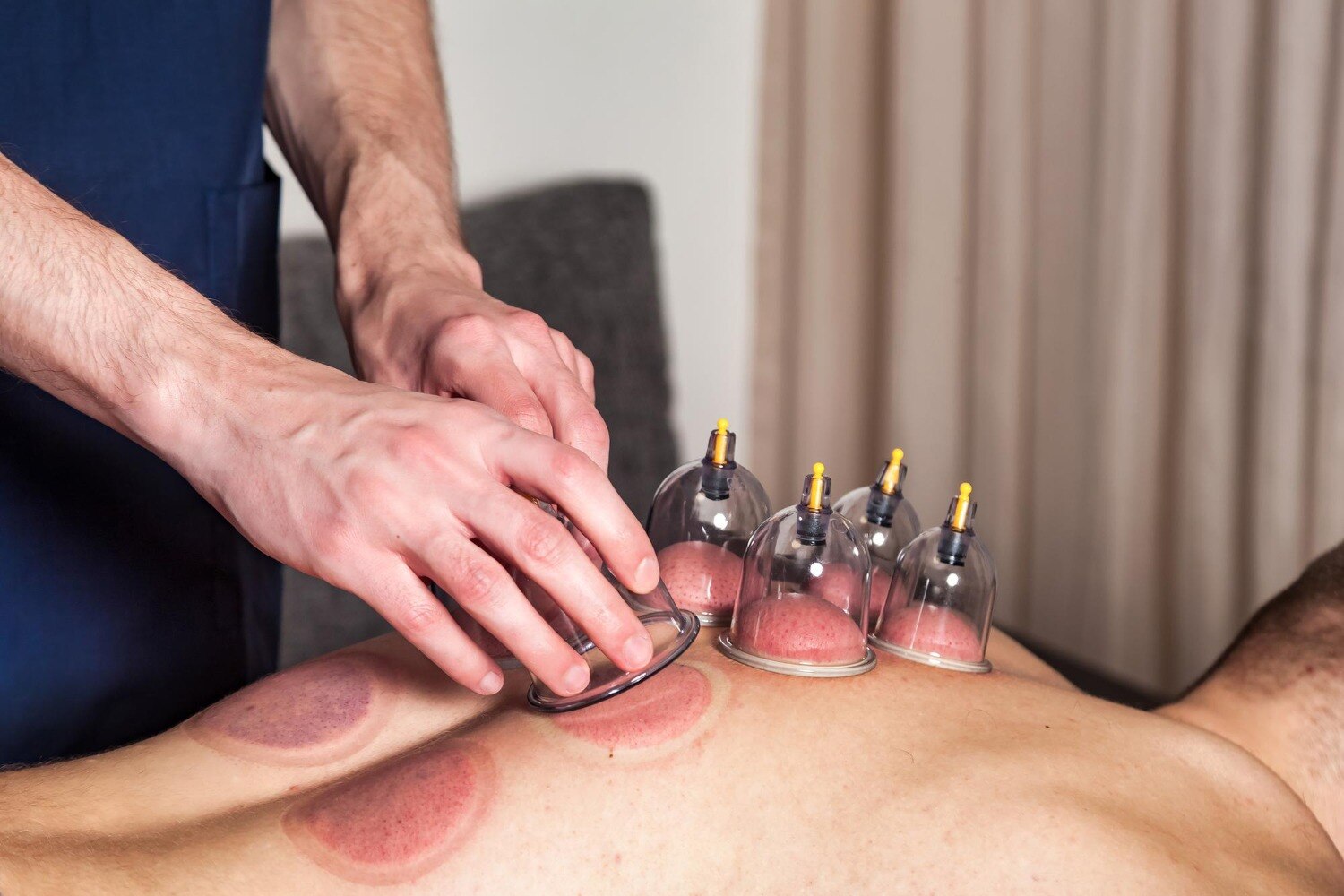
Cupping changes pressure at the skin; manual therapy changes how a practitioner loads or moves tissue and joints. Dry cupping uses suction cups that pull skin and superficial tissue upward, leaving temporary circular marks from small blood-vessel rupture. Wet cupping pierces the skin and draws blood, adding infection and blood-exposure risks.
Cupping versus manual therapy in Bengaluru is therefore not a like-for-like choice.
| Option | Physical action | Pain pattern it may suit |
|---|---|---|
| Dry cupping | Suction lifts skin and superficial tissue | Short-term relief for widespread post-exercise tightness when marks and skin sensitivity are acceptable |
| Manual therapy | Massage, soft-tissue work, joint mobilisation, or manipulation applies directed pressure or movement | A measurable restriction in joint range, local muscle guarding, or pain that eases when a specific movement is assisted |
| Progressive exercise | Gradually increases muscle force, range, balance, and load | Reduced strength, poor load tolerance, recurring strain, or return to work or sport |
Diffuse delayed-onset soreness does not require a preferred passive technique; gentle movement and graded loading usually address the underlying conditioning need. A focal strain, tendinopathy, joint problem, or nerve-related pain needs assessment before either option, because suction or massage can irritate the wrong structure.
Ask what change will be measured after treatment: pain during a squat, shoulder range, walking speed, or lifting tolerance. If relief lasts only through the appointment, use it as a bridge to exercise, not as the conditioning plan.
What does a conditioning plan look like after pain settles?
Progressive exercise is what restores capacity after muscle pain settles; passive treatment earns its place only if it produces a measurable change that helps you train. The physiotherapist records baseline range of motion, strength, walking, lifting, or sport-specific tasks, then chooses the least invasive tool that improves the next step.
| Option | What it involves | When it applies |
|---|---|---|
| Manual therapy for conditioning | Joint mobilisation, massage, manipulation, or soft-tissue work | A movement restriction or pain response is limiting exercise; the effect must carry into training |
| Cupping | Suction cups pulling on the skin and superficial tissues | Short-term symptom relief helps you move; bruising, skin condition, and lasting benefit require review |
| Needling | Fine needles placed in selected muscle or pain-related tissue | A specific assessment supports it as an adjunct, not as a replacement for loading |
| Progressive exercise | Increasing resistance, range, speed, balance, or task complexity | The main route to strength, load tolerance, coordination, and work or sport readiness |
A safe sequence links each session to the next:
- Assess the cause, baseline function, and warning signs.
- Use hands-on treatment, cupping, or needling only when it enables better movement or exercise.
- Build mobility, strengthening, balance, and task-specific drills, increasing one training demand at a time.
- Reassess walking, lifting, strength, or sport tasks and set the next target.
Mild exercise discomfort can occur. If pain remains clearly worse the next day, reduce the dose and review the diagnosis rather than adding more passive treatment; return to full work or sport follows repeatable, pain-controlled performance, not one good treatment session.
When should you avoid cupping or hands-on treatment?
Do not start with cupping or hands-on treatment if the pain could signal damage that needs diagnosis. Seek medical assessment for sudden severe pain, a deformity, inability to bear weight, rapidly increasing swelling, fever, unexplained weight loss, chest pain, or pain after a significant fall or collision.
| Finding | Why cupping or manual therapy is not the first step | Safer action |
|---|---|---|
| Numbness, spreading tingling, new weakness, or loss of bladder or bowel control | May indicate nerve or spinal involvement; treatment could delay urgent care | Arrange prompt medical evaluation |
| Suspected fracture, tendon rupture, or acute muscle tear | Pressure, stretching, or suction can worsen injured tissue | Protect the area and obtain an examination |
| Open wound, rash, cellulitis, infected skin, or active inflammation | Suction and friction can spread infection or damage the skin | Keep it clean and seek clinical advice |
| Large bruise, unexplained bruising, or a bleeding disorder | Cupping can increase bleeding and tissue damage | Ask a doctor before any treatment |
| Anticoagulant use or poor wound healing | Wet cupping adds bleeding, infection, and blood-exposure risks | Get clearance and discuss alternatives |
Stop treatment if pain becomes sharp, symptoms travel down a limb, weakness appears, or bruising increases after a session. Wet cupping requires single-use sterile needles or lancets, skin preparation, hand hygiene, and safe sharps disposal; without those controls, do not proceed.
Once serious causes are excluded, use hands-on care only to enable measured mobility or exercise, not to replace progressive loading.
How do you judge whether physiotherapy is restoring capacity?
A useful result is not “it felt looser after treatment”; it is a task you can perform better and repeat. At the first visit, record pain during the target activity, joint range, strength, walking or lifting tolerance, and the work or sport task that currently fails. Repeat those measures under similar conditions.
| Measure | Meaningful improvement | Warning sign |
|---|---|---|
| Strength | More resistance or repetitions with controlled form | The painful side remains weaker |
| Range and control | Greater movement without compensation | Motion improves only immediately after treatment |
| Load tolerance | More walking, lifting, running, or training before symptoms rise | The same workload causes a larger flare |
| Function | Easier stairs, reaching, squatting, or job duties | Daily tasks remain unchanged |
| Recovery | Symptoms return to baseline by the next day | Pain and stiffness stay worse the next day |
Cupping or manual therapy for conditioning in Bengaluru should earn its place by improving a measurable starting point, such as enabling a deeper squat or better shoulder movement. If relief lasts only through the appointment and exercise performance does not improve, the plan needs review.
A clinic such as Apex Physiotherapy can connect symptom relief with lasting capacity by documenting your baseline, using hands-on treatment only to enable movement, then progressing resistance, range, speed, or complexity and retesting the same task. Ask what result will be measured and what progression follows it.
Related services
Cupping Cupping Therapy is an effective physiotherapy treatment used to relieve muscle tension, reduce pain, improve blood circulation, and support faster recovery. |
Manual Therapy Manual Therapy is a specialized hands-on physiotherapy technique designed to reduce pain, improve mobility, restore joint function, and accelerate... View service → |
Frequently asked questions
How can you tell ordinary soreness from an injury or warning sign?
Ordinary post-exercise soreness usually affects both sides of the worked muscles and improves over several days. Sharp pain, a sudden pop, bruising, major weakness, joint locking, numbness, or symptoms that worsen with daily activity need assessment for a tear, tendon problem, joint condition, or nerve involvement.
What is the difference between cupping and manual therapy for conditioning?
Cupping uses suction on the skin and may provide short-term relief or a change in perceived tightness. Manual therapy includes techniques such as soft-tissue work and joint mobilisation to address specific movement restrictions. Neither builds strength or replaces a progressive conditioning plan.
What does conditioning look like after muscle pain settles?
Start with comfortable range-of-motion exercises and low-load isometric work. Progress to resistance, larger movement ranges, faster contractions, balance, and task-specific drills while monitoring pain, swelling, strength, and next-day response.
When should you avoid cupping or hands-on treatment?
Avoid treatment over broken or infected skin, unexplained swelling, active bleeding, a suspected blood clot, or an undiagnosed acute injury. Seek urgent medical care for severe weakness, loss of sensation, chest pain, breathlessness, or rapidly increasing swelling.
How do you know whether physiotherapy is restoring capacity?
Track measurable changes such as walking distance, joint range, strength, balance, lifting tolerance, training volume, and recovery by the next day. Capacity is improving when you perform more useful activity with stable or reduced symptoms, not merely when treatment feels comfortable.
Keywords