Difficulty rising from a chair, climbing stairs, carrying groceries, or recovering after a trip can signal more than ordinary ageing. You will learn how to identify urgent warning signs, understand what an assessment measures, and judge whether a conditioning plan is safe, progressive, and practical at home.
Key takeaways
- Get assessed when strength loss affects several daily tasks.
- Measure chair rises, walking, balance, stair ability, and recovery.
- Build usable strength with sit-to-stands, step-ups, carries, and balance work.
- Stop exercise for chest pain, faintness, severe breathlessness, or sudden weakness.
When strength loss needs assessment rather than more exercise
A slower chair rise, difficulty climbing stairs, trouble carrying groceries, less outdoor walking, or poor recovery after a trip signals more than ordinary ageing when these changes affect daily life or several tasks at once. A noticeable decline deserves assessment rather than simply adding exercise.
Weakness that develops gradually after bed rest, hospitalisation, pain, inactivity, or poor nutrition may be reversible deconditioning. Similar problems can also reflect sarcopenia, arthritis, neurological disease, medication effects, or cardiopulmonary illness; each needs a different treatment and referral plan.
Ask what changed, when it began, and whether pain, breathlessness, dizziness, appetite, or a new medicine appeared with it.
EWGSOP2 uses low muscle strength as an entry point for sarcopenia assessment. The thresholds include hand-grip strength below 27 kg in men or 16 kg in women, or taking 15 seconds or more to complete five chair rises. These figures support clinical assessment, not self-diagnosis; technique, pain, balance, and the testing device affect results.
Seek urgent medical assessment for:
- Sudden or rapidly worsening weakness
- One-sided weakness, facial droop, or speech difficulty
- Chest pain, fainting, or severe breathlessness
- New confusion or unexplained weight loss
- A new inability to stand or walk
- A fall with possible fracture
Do not increase exercise until these problems have been assessed. A clinician can identify whether conditioning is appropriate and what medical cause needs attention first.
What a conditioning assessment should measure
An evaluation measures what the older adult can do safely, not how one painful joint looks. The clinician establishes a baseline for strength, mobility, endurance, balance, and daily independence.
- Record repeated sit-to-stand performance, walking speed, gait pattern, stair ability, and transfers such as bed-to-chair or toilet-to-standing.
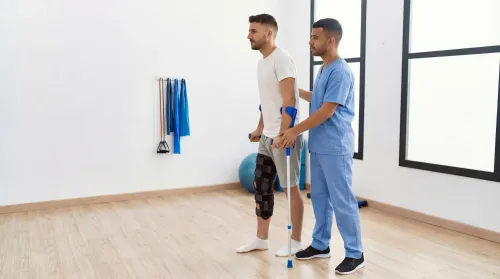
- Observe balance while turning, reaching, changing direction, and walking with or without a walking aid.
- Check joint and spinal range of motion, pain, fatigue, walking tolerance, and how quickly the person recovers after activity.
- Review falls history, near-falls, fear of falling, and what happened during each incident.
- Ask about the home setup, including stairs, bathroom supports, loose rugs, lighting, footwear, walking aids, transport, and help available.
- Ask when medicines are taken, whether they cause dizziness or weakness, and whether symptoms change after a dose.
- Discuss appetite, recent weight change, swallowing or dental problems, and goals such as bathing independently, shopping, walking outdoors, or returning to a hobby.
Muscle size and body weight can mislead: an older adult may look muscular or weigh the same while losing usable force, endurance, or balance. Conversely, low weight does not identify the exact cause of weakness.
Before increasing exercise, the clinician coordinates with a physician for chest symptoms, fainting, severe breathlessness, neurological changes, recent surgery, major pain, or complex disease. A dietitian can address poor intake or swallowing concerns. When comparing “geriatric physiotherapy near me,” ask whether this functional assessment and referral process is included.
Which exercises build usable strength in later life
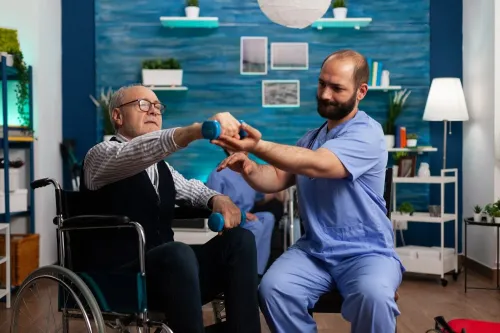
Stretching and walking alone do not rebuild the force needed to rise from a chair or climb stairs. Senior strength rehabilitation usually begins with supported sit-to-stand practice, heel raises, hip and knee strengthening, trunk-control exercises, and supported step-ups.
| Activity | Main target | Progression |
|---|---|---|
| Progressive resistance | Force production | Body weight, resistance bands, weights, then machines |
| Walking intervals | Activity tolerance | Longer intervals, faster pace, stairs, and varied surfaces |
| Balance and function | Turning, uneven ground, trip recovery | Supported reaching, obstacles, direction changes, and carrying tasks |
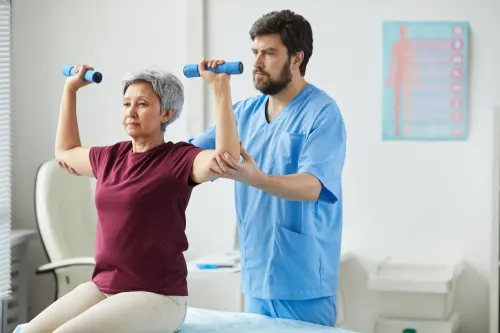
Progressive resistance is the part that directly challenges force production. A clinician may later add pulling and pushing movements, heavier loads, stairs, walking intervals, obstacle negotiation, and functional reaching, such as placing an object on a shelf while standing safely.
The clinician changes repetitions, sets, resistance, range of motion, speed, hand support, and movement complexity only after the older adult shows controlled movement and recovers well.
A person might move from using both hands during a chair rise to one hand, then no hand support; a step-up might progress from a low step to a higher step or repeated stairs. Balance drills specifically address turning, uneven ground, and recovering from a trip, which stronger legs alone do not guarantee.
The correct starting level depends on pain, surgery, neurological or heart-lung conditions, falls, and current function. Do not copy a routine unsupervised; ask for an assessment and clear stop rules.
How often should older adults exercise, and when should they stop
For generally healthy older adults, the WHO benchmark is muscle-strengthening work for all major muscle groups on at least 2 days each week, 150–300 minutes of moderate aerobic activity weekly, and multicomponent balance-and-strength activity on at least 3 days when appropriate. Walking alone may not overload weak legs enough.
Frail adults and people with diabetes, heart or lung disease, osteoporosis, neurological conditions, recent surgery, significant pain, or falls may need a lower starting dose with supervision. Begin with manageable effort: breathe steadily, take planned rests, accept short-term muscle fatigue, and stop if pain escalates or changes movement.
Recovery by the next day matters; lingering exhaustion or a symptom flare means the dose was too high.
Stop exercise and seek medical assessment for:
- Chest pain or fainting
- Severe breathlessness
- Sudden neurological symptoms, such as facial droop, speech difficulty, or one-sided weakness
- Rapidly worsening weakness
- A new inability to stand or walk
- A fall with suspected fracture
One or more supervised sessions weekly can establish safe technique and adjust the plan. Prescribed home practice, caregiver help, and transport planning improve consistency. Progress through measurable changes: more controlled chair stands, longer walking, faster gait, or increased resistance. That staged approach makes conditioning for older adults in Bengaluru safer after inactivity.
How to choose geriatric rehabilitation in Bellandur for strength loss
A good local service starts with measurement, not a generic exercise sheet. Ask whether the clinician records chair-stand performance, walking speed, gait, balance, transfers, pain, endurance and falls history, then screens for medical red flags before increasing effort.
Ask these questions when comparing providers:
- Do you review medicines, dizziness or sedation, appetite, weight loss, swallowing, dental problems and nutrition-related strength loss?
- Do sessions train balance, turning and recovery from a trip as well as resistance and walking?
- Will you receive a written home plan showing progression, rest periods and stop rules?
- How will exercises change for pain, recent surgery, neurological disease, heart or lung conditions, walking aids and actual tasks such as bathing, stairs, shopping or getting out of a chair?
| Option | What to check | Why it matters |
|---|---|---|
| Clinic-based | Supervision, equipment and repeat measures | Useful for progressive resistance and measurable change |
| Home-based | Home hazards, transfers and daily tasks | Tests whether gains work where falls occur |
| Hospital-linked | Referral and physician coordination | Safer when disease, surgery or medication effects complicate exercise |
Location matters less than assessment quality, supervision, follow-up measurement and referral coordination. That applies whether you search “geriatric rehabilitation for conditioning older adults losing strength bellandur,” “geriatric rehabilitation bellandur” or “geriatric physiotherapy near me.”
Apex Physiotherapy can be considered by Bengaluru residents seeking an individualised conditioning assessment in Bellandur, provided the service addresses the older adult’s specific strength, balance, endurance and daily-life goals.
Related service
Geriatric Rehabilitation Geriatric Rehabilitation is a specialized physiotherapy service designed to improve mobility, strength, balance, and overall physical function in... View service → |
Frequently asked questions
When does strength loss in an older adult need assessment?
Arrange an assessment when slower chair rises, stair difficulty, reduced walking, trouble carrying groceries, or poor recovery affects daily life or several tasks together.
What does a conditioning assessment measure?
A conditioning assessment can measure chair-rise performance, walking speed, balance, stair ability, grip or leg strength, endurance, pain, fatigue, and recovery after activity.
Which exercises build usable strength in later life?
Sit-to-stands, step-ups, supported squats, calf raises, carrying exercises, walking, and balance drills build strength that transfers to daily activities.
How often should older adults exercise, and when should they stop?
Exercise frequency depends on strength, health conditions, symptoms, and recovery. Stop and seek medical advice for chest pain, fainting, severe breathlessness, sudden weakness, or new neurological symptoms.
How do you choose geriatric rehabilitation in Bellandur for strength loss?
Choose a clinic that assesses daily function, reviews medical history and medicines, sets measurable goals, adapts exercises to pain and balance, and tracks progress over time.
Keywords