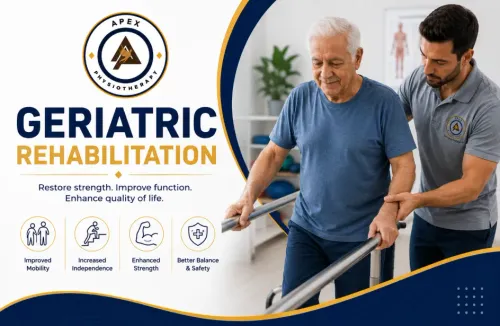
Older adults may experience reduced strength, slower walking, joint stiffness, balance difficulty, or declining confidence after illness, injury, surgery, or a fall. When these changes begin affecting personal care and household activities, a general exercise routine may not provide enough guidance.
Apex Physiotherapy Clinic offers geriatric rehabilitation therapy based on the older adult’s medical condition, functional abilities, home environment, and level of family support. The objective is to make everyday movement safer and support as much independence as realistically possible.
When Is Geriatric Rehabilitation Appropriate?
An older adult may benefit from assessment when there is:
- Difficulty standing from a chair
- Dependence during walking
- Repeated falls or near-falls
- Fear of moving without assistance
- Weakness after hospitalisation
- Reduced mobility following surgery
- Joint pain affecting daily activities
- Difficulty climbing stairs
- Poor balance while turning
- Declining walking endurance
- Increased reliance on family members
A sudden decline should not be dismissed as a normal part of ageing. New confusion, one-sided weakness, chest discomfort, severe dizziness, or abrupt walking difficulty requires urgent medical assessment.
Readiness Indicators for Rehabilitation
Geriatric rehabilitation may be suitable when the person is medically stable and able to participate at some level. The patient does not need to be fully independent before beginning.
Important readiness indicators include:
- Medical clearance when required
- Ability to follow simple instructions or participate with caregiver support
- Identifiable mobility or functional limitations
- A safe setting for supervised activity
- Realistic goals shared by the patient and family
- Willingness to practise recommended activities consistently
Fatigue, pain, blood pressure changes, and other health concerns must be considered while planning each session.
What a Suitable Programme Should Include
A comprehensive programme may address strength, balance, flexibility, walking, endurance, and task-specific movement.
Treatment can include practising bed mobility, standing from different chair heights, walking with an appropriate aid, turning, using stairs, and navigating common household spaces. Exercises should be challenging enough to encourage progress but supported sufficiently to reduce avoidable risk.
Caregiver education may cover safe assistance, positioning, use of mobility aids, and home exercise supervision. Family members should learn how to support movement without pulling unsafely or completing every task for the older adult.
Selecting Geriatric Rehabilitation Therapy in Bellandur
Families seeking geriatric rehabilitation therapy in Bellandur should look for individual assessment rather than a standard senior exercise package. The physiotherapist should understand the patient’s diagnoses, medication-related concerns, fall history, previous mobility, and home setup.
Local living conditions also matter. Apartment lifts, bathroom layouts, uneven footpaths, basement parking, and Bengaluru traffic can affect how safely an older adult moves outside a controlled clinical setting.
Progress should be measured through meaningful abilities, such as walking to the dining area, using the bathroom more safely, rising with less assistance, or tolerating a short outdoor walk. Age alone should not determine the rehabilitation goal.
Families looking for structured support can book a geriatric assessment with Apex Physiotherapy Clinic. The physiotherapist can identify current risks, recommend practical goals, and guide both the older adult and caregiver through an appropriate rehabilitation plan.
Keywords